YACHT &
PRIVATE AVIATION
A yacht berthed in Dubai Marina or a charter aircraft out of Al Maktoum is a private space maintained by a rotating population: crew, charter guests, yard contractors, handling agents. Ownership is not the same as control.
Privacy sweeps for yachts and private aircraft
Vessels and aircraft used by principals in the Gulf combine two conditions that matter: extremely candid conversation, and an access list far longer than the owner's household. A yacht goes into the yard and returns with new joinery and new cabling. An aircraft is chartered out between owner trips. Crew rotate seasonally.
The check is therefore event-driven rather than calendar-driven. You sweep after the yard, after a charter, and after crew change — the three moments when the access list actually changed.
- New joinery, panelling, lighting or AV installed during a refit without a matching work order
- Devices with a clear view of the owner's cabin, saloon or main conference seating
- Cabling runs added during yard work that terminate somewhere nobody can explain
- An unfamiliar device persisting on the vessel or aircraft network after a reboot
- Equipment left behind after a charter period, particularly chargers and adapters
Step by step,
in order.
Sweep on the trigger, not the calendar
After yard work, after each charter, and after crew change. These are the moments the access list changed; the dates between them are quiet.
Baseline on the dock or the apron
Marina and airport RF environments are dense and busy. Take an external reading first so an interior rise means something.
Clear the private spaces first
Owner's cabin, saloon and any space used for calls. Guest cabins and crew areas follow. Confined interiors reward slow, close work over speed.
Interrogate the refit
Concentrate on everything installed or disturbed in the yard: joinery voids, headliners, AV, lighting, new cable runs. A refit is the single best opportunity anyone gets.
Audit the onboard network
Account for every device on the vessel or cabin network, and rotate credentials issued to yard contractors, charter guests and departing crew.
Inspect optically
Storage-only recorders do not transmit and will not appear on an RF sweep. Lens detection across the private spaces closes that gap.
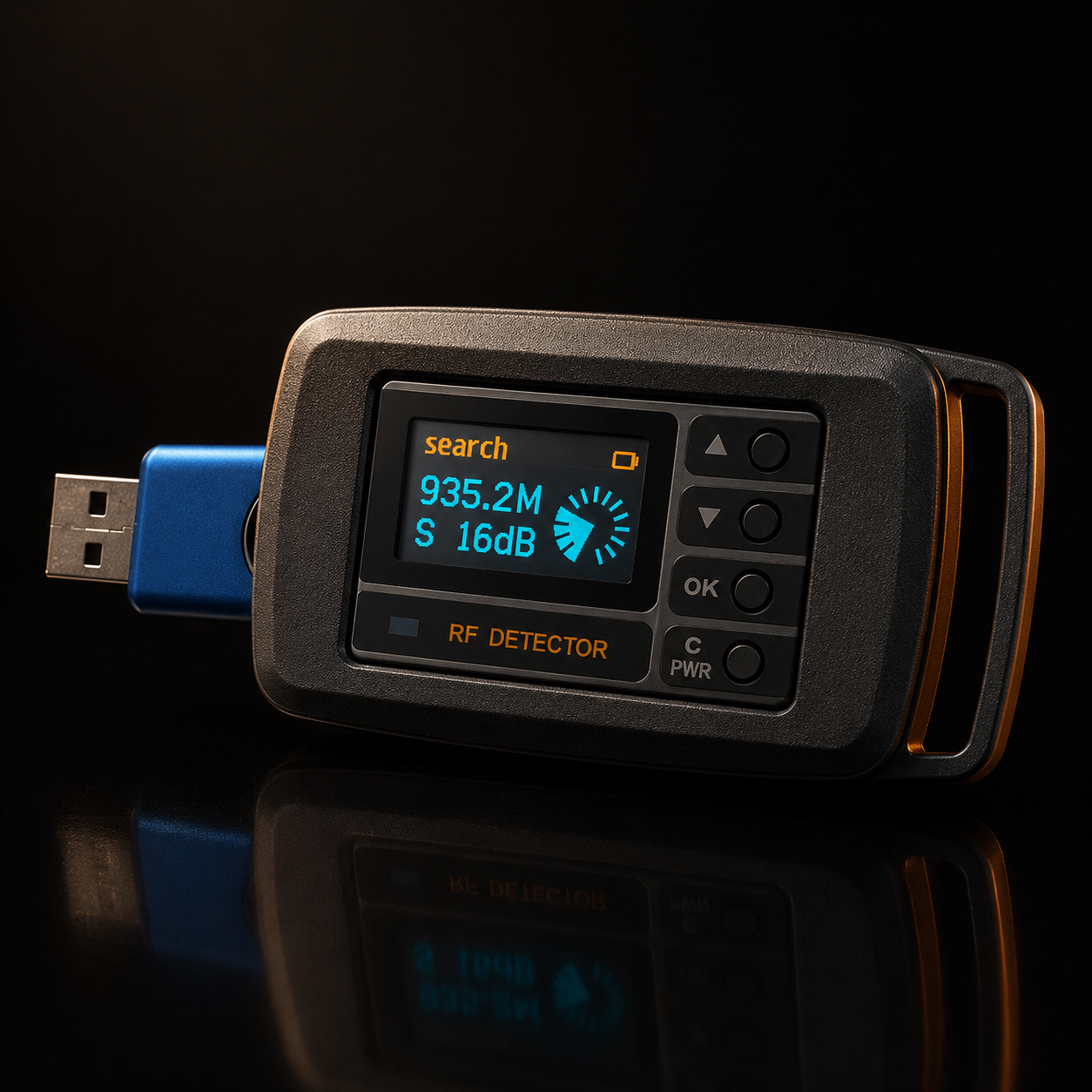

- Metallic hulls, airframes and dense cabling create reflections and dead spots. Sweep slowly and expect to repeat sections.
- A clear result covers the vessel or aircraft as of that inspection, not the next charter.
- Detection does not replace crew vetting, key control and a documented contractor policy — it verifies them.
- Carrying detection equipment across borders engages the import rules of each destination. Check the position for every port and airport on the itinerary.
Frequently
asked.
When should a yacht be swept?
After yard periods, after each charter, and after crew rotation. Refits are the highest-exposure moment by a wide margin, because contractors have extended unsupervised access to open joinery and cable runs.
Can a private jet cabin be swept the same way?
The method transfers, with two differences: the interior is smaller and denser, and the apron environment is electrically noisy. Baseline outside the aircraft and work the cabin slowly, concentrating on the seating used for conversation.
Does a metal hull interfere with RF detection?
It reflects and creates dead spots, so readings are less clean than in a hotel room. The answer is a slower pass with more overlap rather than different equipment, and closer attention to optical and physical inspection.
Who typically plants devices on a charter vessel?
In practice the realistic cases involve people with lawful access — a departing crew member, a contractor during a refit, or equipment left behind after a charter. That is why the sweep triggers are access events rather than a fixed schedule.
Can I keep detection equipment permanently on board?
Many owners do, but equipment crossing borders is subject to the import and telecoms rules of each destination, and these vary sharply across the Gulf and Mediterranean. Confirm the position for your itinerary before treating it as permanent inventory.
Executive & boardroom meetings
Protect a sensitive meeting: sweep the room, control signals, secure the calls.
Family office & DIFC boardroom
Meeting hygiene for family offices and investment committees in Dubai, Abu Dhabi and Riyadh.
Hotel room sweep
Check a room for hidden cameras and transmitters before you take the first call.
Find a GPS tracker on your car
Where trackers are hidden, how to detect them, and what a detector can actually see.
Airbnb & short-term rental check
A privacy check for rentals, where hosts control the fixtures and the network.
Executive travel in the Gulf
A repeatable privacy check for suites, meeting rooms and cars across Dubai, Riyadh and Doha.
Villa & household privacy
Check a villa or serviced residence where contractors, staff and agents have all held keys.