VILLA
PRIVACY CHECK
A villa in Dubai or Riyadh passes through a long list of hands before it is yours: developer, agent, fit-out crew, maintenance contractor, household staff. Each handover is a key, and keys are rarely counted back in.
Privacy sweeps for villas and serviced residences
Residential sweeps in the Gulf are usually prompted by a transition rather than a suspicion: a new villa handed over, a renovation finished, a driver or housekeeper leaving, a short-let period ending. In each case a number of people had lawful access to unoccupied rooms for extended periods — which is the condition a concealed device needs.
A residence is larger than a hotel room, so the method changes. You are not doing one continuous sweep; you are clearing rooms one at a time, in priority order, and keeping a record of which rooms have been done.
- New or replaced fittings after a handover: smoke detectors, sensors, sockets, light fixtures
- Devices in private rooms — bedrooms, dressing rooms, bathrooms — with a clear line of sight
- Network equipment or cabling added during a fit-out that nobody can account for
- An unfamiliar device on the household Wi-Fi, particularly one that reappears after a reboot
- Cameras installed for security whose coverage extends into private interior space
Step by step,
in order.
Prioritise the rooms
Bedrooms, dressing rooms, private studies and any room used for calls come first. Hallways and utility spaces can wait — clear the rooms where privacy actually matters.
Baseline the property
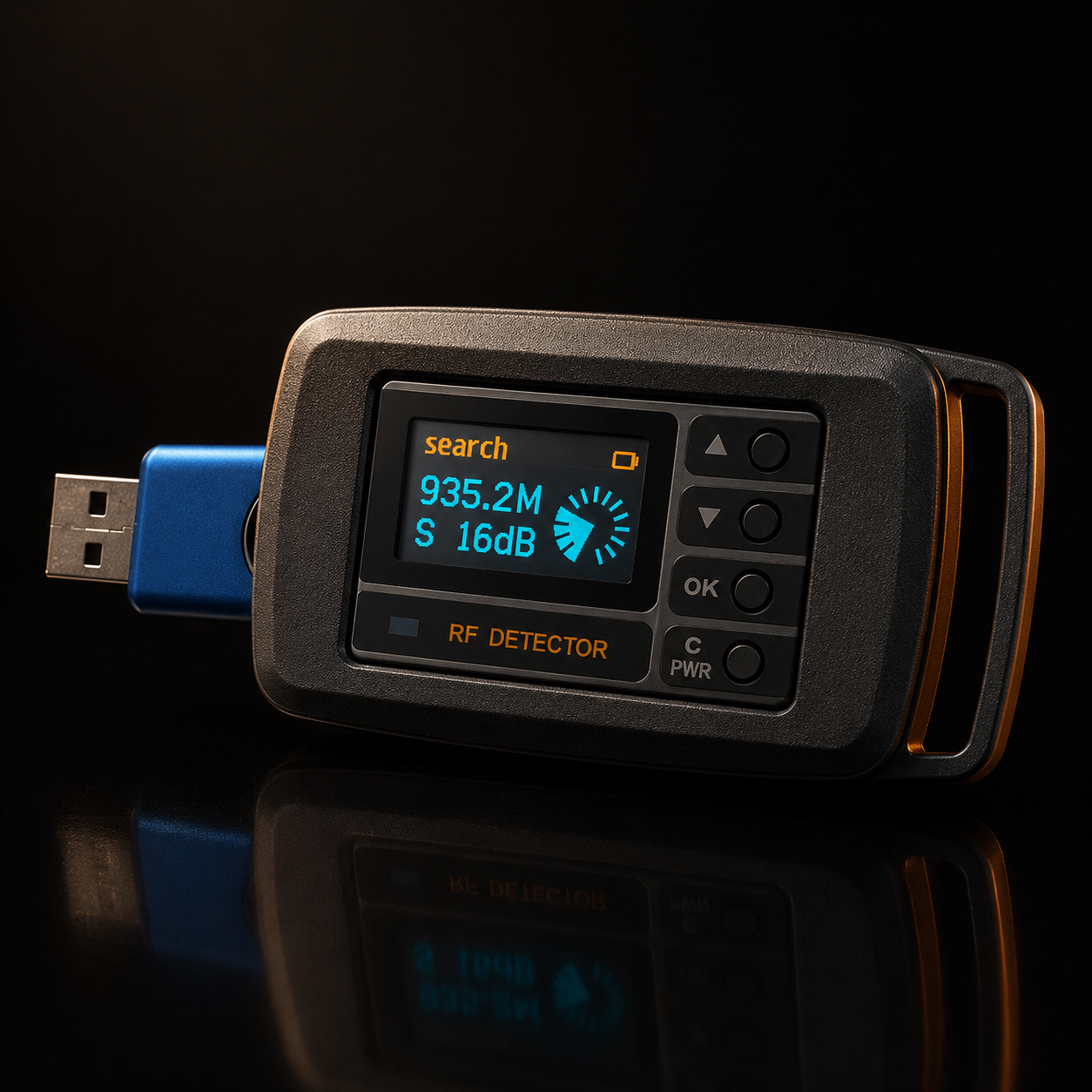
Take a reading outdoors and in a room you consider low risk. Villas carry their own dense Wi-Fi, smart-home and irrigation-controller traffic, and you need to know what normal looks like.
Sweep room by room
Perimeter at chest height, then knee height, then the fixtures overhead. Finish a room fully and note it before moving on, so you never lose track of what has been cleared.
Interrogate the fit-out
Concentrate on anything installed or replaced by contractors: detectors, sensors, sockets, mirrors, joinery voids and ceiling fittings above private areas.
Audit the network
List every device on the household Wi-Fi and account for each one. Change the router and guest credentials that contractors and previous staff were given.
Re-check after access
Repeat the priority rooms after any period when contractors or new staff had unsupervised access. A residence is cleared as of a date, not permanently.
What this
actually takes.
- A sweep is a snapshot. It tells you about the property on the day, not about access granted afterwards.
- RF detection cannot see a device that records to internal storage and never transmits — that remains an optical and physical search.
- Wired cameras installed as part of a building's own security system are a documentation and consent question, not a detection one.
- Monitoring household staff is legally sensitive in every GCC state. This method is about protecting your own private space, not about placing anyone under observation.
Frequently
asked.
When should I sweep a new villa in Dubai?
At handover, after any significant fit-out or renovation, and whenever household staff with unsupervised access change. Those three moments cover most of the realistic risk, and each is a natural point to run the priority rooms again.
How long does a full villa sweep take?
Between forty-five and ninety minutes for a typical villa, depending on size and how much of the fit-out is new. Clearing only the priority rooms — bedrooms, dressing rooms, private study — takes considerably less and covers most of the exposure.
Can I detect a camera hidden by a previous tenant or contractor?
If it transmits, an RF sweep will find it. If it records to a card and is collected later, detection depends on optical lens search and physical inspection of new or replaced fittings — which is why the method covers both.
Is it legal to install cameras in my own villa in the UAE?
Recording your own property is generally permissible, but UAE law is strict about recording people without consent, including household staff and guests, and penalties are significant. Cameras covering private interior areas are the problem case. Take local advice rather than assuming.
Do I need a professional sweep or can I do it myself?
A structured self-check with a good RF detector covers consumer-grade devices, which is the overwhelming majority of what is found in residences. Bring in a professional team where the threat is credible and targeted, or where you may need findings to stand up formally.
Hotel room sweep
Check a room for hidden cameras and transmitters before you take the first call.
Find a GPS tracker on your car
Where trackers are hidden, how to detect them, and what a detector can actually see.
Airbnb & short-term rental check
A privacy check for rentals, where hosts control the fixtures and the network.
Executive travel in the Gulf
A repeatable privacy check for suites, meeting rooms and cars across Dubai, Riyadh and Doha.
Executive & boardroom meetings
Protect a sensitive meeting: sweep the room, control signals, secure the calls.
Family office & DIFC boardroom
Meeting hygiene for family offices and investment committees in Dubai, Abu Dhabi and Riyadh.
Yacht & private aviation
Clear a cabin or charter aircraft where crew, charter guests and yard contractors rotate.