FAMILY OFFICE
MEETING SECURITY
A Gulf family office runs the most sensitive conversations in the region through a handful of rooms — succession, allocation, a transaction that moves a market. The rooms are usually leased, shared or serviced, and cleaned by someone else.
Meeting security for Gulf family offices
Family offices in DIFC, ADGM and Riyadh concentrate decision-making into very few people and very few meetings. That is efficient, and it is also what makes the meeting itself the highest-value target in the structure. The exposure is rarely a network intrusion — it is audio from a room, or a phone left on the table by someone who was invited.
The discipline that works is unglamorous: a fixed pre-meeting routine applied to every session that matters, rather than an extraordinary response once something has already leaked.
- A meeting room accessible to building facilities, cleaning or AV contractors between sessions
- New AV equipment, conference units or cabling installed without a documented work order
- Attendees' phones, smartwatches and laptops remaining in the room during closed sessions
- An RF reading inside the room that does not match the baseline taken in the corridor
- Adjacent rooms or corridors within audio range of the conference table through a shared wall
Step by step,
in order.
Fix the room
Use a small number of known rooms for sensitive sessions rather than whatever is free. You cannot build a baseline for a room you use once.
Baseline and sweep before the session
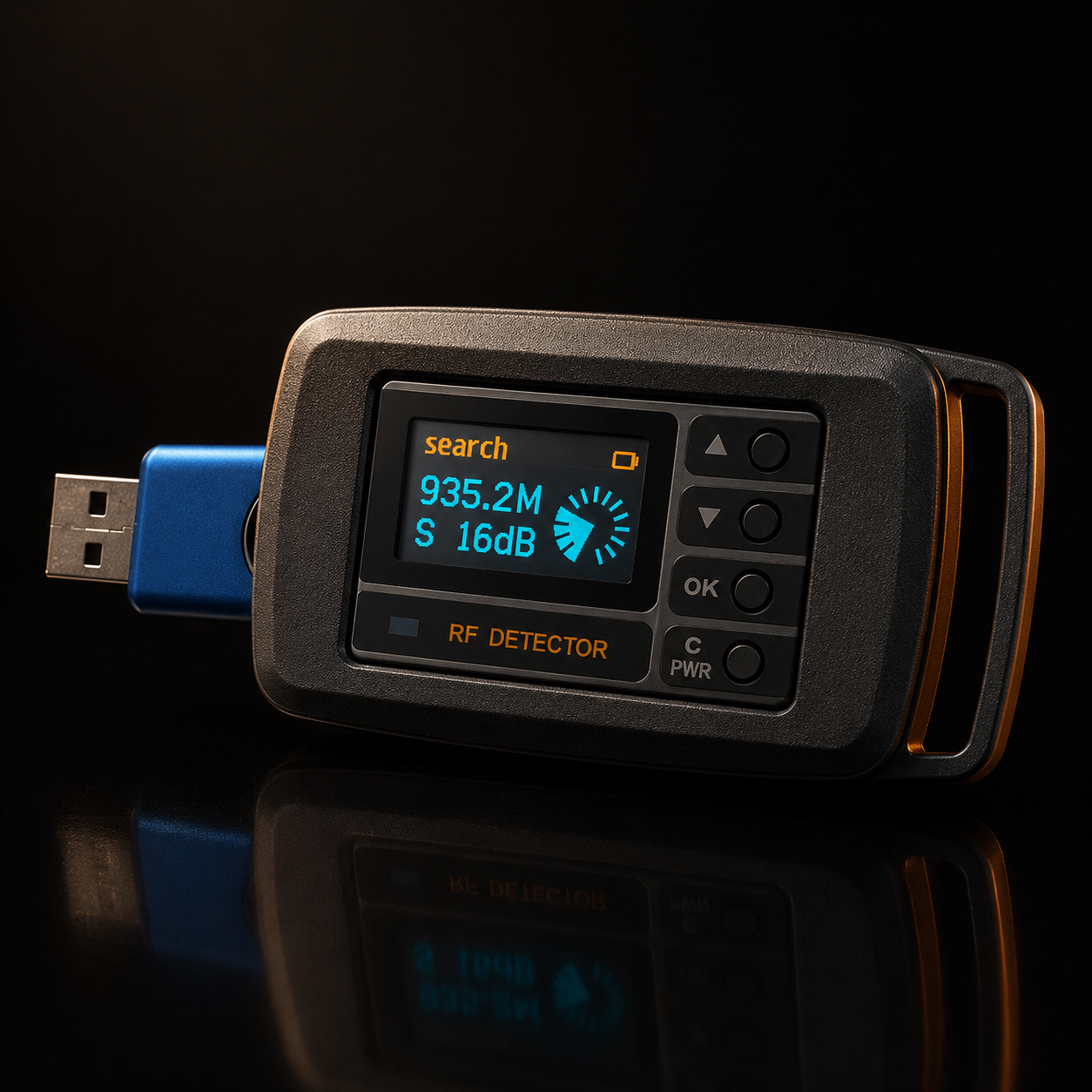
Read the corridor, then the room, in the hour before the meeting — not the day before. Access between the sweep and the session is the gap that matters.
Work the table and the AV
Concentrate on the conference unit, ceiling microphones, display, cabling and anything mounted with a view of the table. Installed AV is the most common concealment point in a fitted boardroom.
Apply a device policy
Personal phones and wearables out of the room and into a box outside, consistently, for every attendee including principals. A policy applied to juniors only is not a policy.
Control the adjacency
Check what shares a wall, a window line or a ventilation run with the room. Structural audio leakage does not require anyone to have entered your space.
Log every sweep
Date, room, operator, result. A record is what lets you answer the question 'when was this room last clear?' honestly during an incident.

- A sweep clears a room for a session. It says nothing about the room tomorrow, or about who enters after you leave.
- RF detection does not address a participant who is simply recording on a permitted device — that is a policy and trust problem.
- Structural audio leakage through walls, glazing and ventilation is a construction issue that detection identifies but cannot fix.
- Anything approaching workplace monitoring engages employment and privacy law in every GCC jurisdiction. This is about protecting the room, not the people in it.
Frequently
asked.
How often should a family office sweep its boardroom?
Before each genuinely sensitive session, and on a routine cycle for the rooms in regular use. The trigger that matters is access: any period when facilities, cleaning or AV contractors were in the room unsupervised resets the clock.
Are DIFC and ADGM offices at particular risk?
The concentration of transactional decision-making in a small number of buildings is what raises exposure, not the jurisdiction. Serviced and shared premises add contractor access, which is the practical variable to manage.
What is the biggest boardroom leak risk?
Audio, and usually from a permitted device rather than a planted one. A phone on the table during a closed session is the most common route, which is why device policy sits inside the method rather than beside it.
Can we run this in-house or do we need a TSCM contractor?
A trained member of staff with good equipment and a fixed routine covers the recurring pre-meeting check well. Bring in a full TSCM team for a credible targeted threat, for a periodic deep inspection, or where findings may need to hold up formally.
Does this cover the family's residences as well?
No — a residence is a different method and a different priority order. Our villa and residence use case covers households, and most family offices end up running both.
Executive & boardroom meetings
Protect a sensitive meeting: sweep the room, control signals, secure the calls.
Yacht & private aviation
Clear a cabin or charter aircraft where crew, charter guests and yard contractors rotate.
Hotel room sweep
Check a room for hidden cameras and transmitters before you take the first call.
Find a GPS tracker on your car
Where trackers are hidden, how to detect them, and what a detector can actually see.
Airbnb & short-term rental check
A privacy check for rentals, where hosts control the fixtures and the network.
Executive travel in the Gulf
A repeatable privacy check for suites, meeting rooms and cars across Dubai, Riyadh and Doha.
Villa & household privacy
Check a villa or serviced residence where contractors, staff and agents have all held keys.